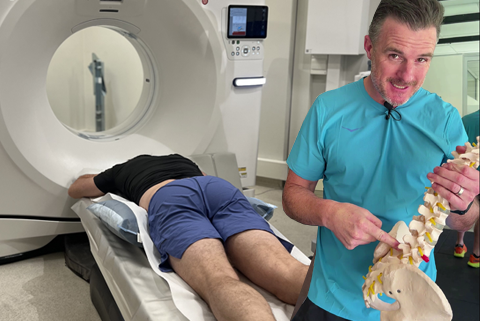
Sciatica
How Do You Know If It's Coming From a Disc?
by Tim Keeley02 Oct 2026


As featured in The Daily Telegraph, Herald Sun and other News Corp publications around Australia.
Sciatica is a term used to describe pain that travels along the pathway of the sciatic nerve, commonly from the lower back or buttock into the back or side of the leg.
It can be caused by several different problems, but one of the most common is irritation or compression of a lumbar nerve root associated with a disc bulge, protrusion or herniation.
The important question is not simply whether you have leg pain.
It is whether the pattern of your symptoms, neurological signs and response to movement suggest that the pain is actually coming from a lumbar disc and nerve root.
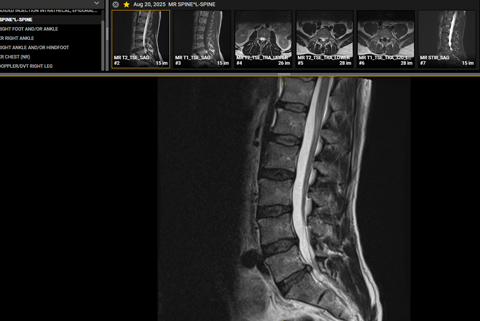
I've Experienced Disc-Related Sciatica Myself
In 2025 I developed a lumbar disc protrusion with significant sciatica.
The symptoms were severe enough that I required an MRI and a corticosteroid injection as part of the management process.
I then worked through a progressive rehabilitation program and ultimately returned to full function with complete resolution of the sciatica.
That experience reinforced something I have seen clinically for many years: a disc injury can cause severe symptoms, but severe symptoms do not automatically mean permanent damage or inevitable surgery.
What Is Disc-Related Sciatica?
The lumbar discs sit between the vertebrae of the lower back and help distribute load through the spine.
A disc can bulge, protrude or herniate and irritate a nearby nerve root.
That irritation may occur because of a combination of mechanical pressure and inflammation around the nerve root.
Depending on which nerve root is affected, symptoms can travel into different parts of the buttock, thigh, lower leg or foot.
Symptoms may include:
- Pain travelling down one leg
- Pins and needles
- Numbness
- Burning or electric-type pain
- Weakness in the leg or foot
- Symptoms aggravated by sitting, bending, coughing or sneezing
How Do We Assess Whether the Symptoms Are Coming From a Disc?
|
|
There is no single test that proves a disc is responsible for sciatica.
Instead, a Physiotherapist combines the history of the symptoms with movement testing, neurological examination and specific nerve-tension tests.
Lumbar Movement Testing
We often assess how symptoms respond to movements such as lumbar flexion, extension, side flexion and rotation.
The important finding is not simply whether a movement feels stiff or sore.
We are looking at whether the movement changes the location or intensity of the leg symptoms.
Centralisation and Peripheralisation
One useful clinical response is known as centralisation.
This occurs when pain that was travelling further down the leg begins to retreat back towards the buttock or lower back with a particular movement or repeated movement.
The opposite is peripheralisation, where symptoms move further down the leg.
These responses can help guide which movements may be appropriate during rehabilitation.
The Straight Leg Raise Test
The Straight Leg Raise is one of the most commonly used clinical tests when lumbar nerve-root irritation is suspected.
While lying on your back, the examiner gradually raises the straight leg.
This increases mechanical loading through the sciatic nerve and lumbar nerve roots.
Reproduction of familiar leg symptoms can contribute to the clinical picture, although the test should not be interpreted in isolation.
|
|
The Slump Test
The Slump Test is another neurodynamic test commonly used when sciatica or nerve-root involvement is suspected.
It combines spinal flexion, knee extension and ankle movement to progressively increase load through the neural system.
Again, the important finding is whether the test reproduces the person's familiar symptoms and whether those symptoms change when different components of the test are altered.
|
|
Do You Need an MRI?
Not everyone with sciatica needs an MRI immediately.
Imaging may become more useful when symptoms are severe, persistent or progressive, when there is significant neurological weakness, when the diagnosis is unclear, or when an injection or surgical opinion is being considered.
MRI findings also need to match the clinical presentation.
Disc bulges and other degenerative changes can be seen in people who have no pain at all, so the scan should never be interpreted without considering the person's symptoms and examination findings.
Can a Disc Herniation Heal?
Yes.
Lumbar disc herniations can reduce in size over time through a process known as spontaneous resorption.
As irritation and inflammation around the nerve settle, symptoms can also improve even before imaging changes are complete.
This is another reason an MRI showing a disc herniation should not automatically be interpreted as permanent structural damage.
Does Disc-Related Sciatica Always Need Surgery?
No.
Many cases of disc-related sciatica improve with conservative management and progressive rehabilitation.
Surgical assessment becomes more important when there is significant or progressive neurological weakness, severe persistent symptoms that are not improving, or signs of a serious neurological complication.
For selected patients, procedures such as lumbar discectomy can relieve pressure on the affected nerve root, but surgery is not the inevitable outcome of having a disc herniation.
What Does Rehabilitation Involve?
Rehabilitation should be based on the individual's symptoms and stage of recovery rather than using one generic set of exercises for everyone with sciatica.
Early treatment may focus on:
- Finding movements or positions that reduce leg symptoms
- Restoring comfortable lumbar movement
- Managing sitting and daily activity
- Gradually restoring walking tolerance
- Introducing appropriate nerve-mobility exercises where indicated
As symptoms settle, rehabilitation should progress towards:
- Core and trunk strength
- Glute and lower-limb strength
- Hip-hinge and lifting mechanics
- Squatting and functional loading
- Progressive return to gym training, running or sport where appropriate
The long-term goal is not simply to settle the sciatica.
It is to rebuild enough movement, strength and load tolerance to return confidently to normal activity.
When Is Sciatica an Emergency?
Most sciatica is not a medical emergency.
However, urgent medical assessment is required if you develop symptoms such as:
- New difficulty controlling your bladder or bowel
- Numbness around the saddle or groin region
- Rapidly progressive weakness in one or both legs
- Significant neurological deterioration
These symptoms may indicate serious compression of the nerves in the lower spine and require urgent assessment.
The Bottom Line
Sciatica is a symptom, not a diagnosis.
A lumbar disc injury is one important cause, but the diagnosis should be based on the whole clinical picture rather than one symptom or one MRI finding.
Movement testing, neurological examination, the Straight Leg Raise, the Slump Test and imaging where appropriate can all contribute to determining whether a lumbar disc and nerve root are involved.
And importantly, disc-related sciatica can recover.
The aim is to settle the nerve irritation, restore movement and progressively rebuild the strength and capacity required for normal life, exercise and sport.
About Tim Keeley
Tim Keeley, B.Phty, Cred.MDT, APAM, is the founder and Principal Physiotherapist of Physio Fitness, a sports injury and rehabilitation clinic in Bondi Junction, Sydney.
With more than 27 years of clinical experience and over 20,000 treatments performed, Tim specialises in sports, fitness and post-operative rehabilitation.
He is also the founder of Physio Rehab, an online platform providing structured injury and surgery rehabilitation programs and an extensive Physiotherapy exercise-video library.
Disclaimer: This article provides general information only and is not a substitute for individual medical or Physiotherapy advice. Seek urgent medical assessment if you develop new bladder or bowel dysfunction, saddle numbness or rapidly progressive neurological weakness.
👉 Book your consultation today or call us on (02) 9389 9100 to have your back and sciatic symptoms properly assessed.

Principal Physiotherapist